
How to Write a Japanese Resume (Rirekisho): A Complete Guide for Foreigners
Every year, thousands of qualified foreign professionals apply for jobs in Japan and never hear back. In many cases, it is not their experience that lets them down — it is their resume. Japan’s job application system operates on a document called the rirekisho (履歴書), a rigidly standardised form that most foreigners have never encountered. Submit a Western-style CV and many Japanese hiring managers will set it aside before reading a single line.
This guide covers everything you need to know to write a rirekisho correctly: what each section requires, what foreigners are permitted to modify, common mistakes that trigger instant rejection, and the specific rules around photos, dates, and self-presentation that determine whether your application advances to the interview stage.
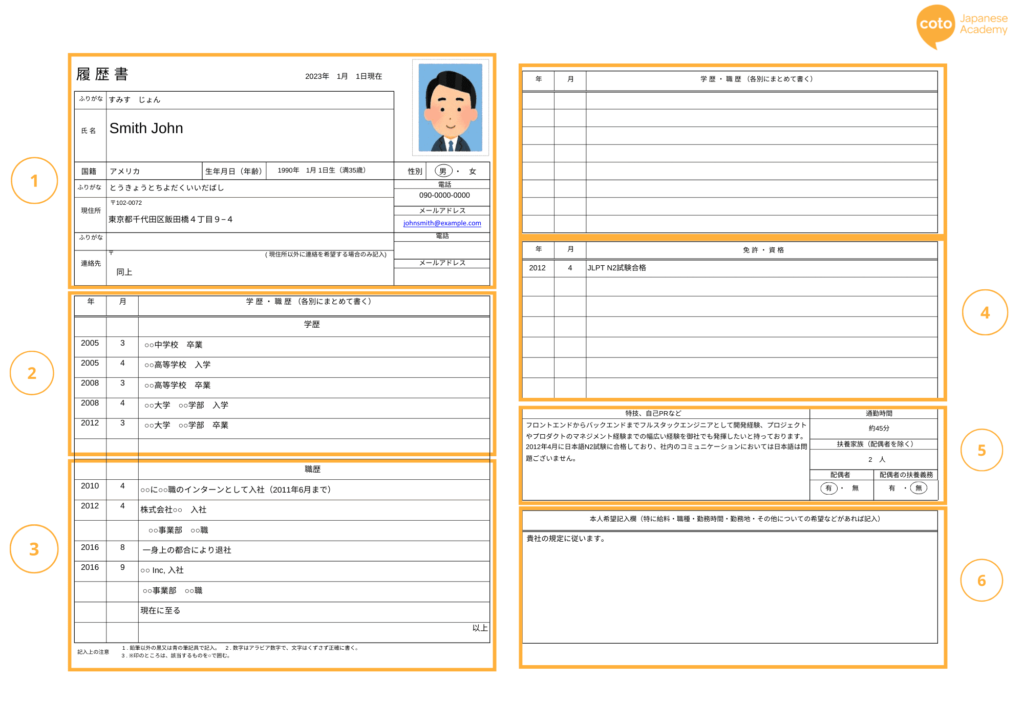
Whether you are applying for your first role in Japan or switching jobs mid-career, the rirekisho is non-negotiable. Get it right, and you signal cultural awareness from the very first page.
What Is a Rirekisho — and Why Is It Nothing Like Your CV?
The rirekisho (literally ‘record of personal history’) is a government-standardised form governed by a Japanese Industrial Standard (JIS) specification. Unlike a Western resume, which gives candidates creative latitude to present their experience, the rirekisho is a fixed-format document with designated fields, prescribed ordering, and strict conventions around presentation.
This standardisation is deliberate. Japanese hiring culture places significant weight on consistency, reliability, and adherence to process. A correctly formatted rirekisho does not merely communicate your qualifications — it demonstrates that you understand how Japanese professional environments function. Deviating from the standard format signals exactly the opposite.
The key distinction to internalise is this: in Western hiring, your resume is a marketing document. In Japan, your rirekisho is a formal record. Creativity in formatting or presentation is not a differentiator — it is a disqualifier.
Rirekisho vs Shokumukeirekisho: Which Document Do You Need?
Many Japanese job applications require two documents submitted together. Understanding the distinction between them is essential before you begin writing.
| Rirekisho (履歴書) | Shokumukeirekisho (職務経歴書) | |
| Format | Fixed JIS template | Free-form |
| Focus | Personal profile, education, qualifications | Detailed work experience and achievements |
| Length | 1–2 pages (single A3 sheet, folded) | 2–3 pages |
| Tone | Formal and factual | Results-oriented, more descriptive |
| Who submits it | Almost all applicants | Mid-career professionals; less common for fresh graduates |
As a general rule: if you are applying to a traditional Japanese company (seishain position), you will need both. If you are applying to an international tech startup or a company that explicitly accepts English applications, a single English CV may suffice — but confirm this before applying.
| Pro tip: This guide focuses on the rirekisho. If you need guidance on writing a shokumukeirekisho, see our companion article: How to Write a Shokumukeirekisho That Gets Interviews. |
Section-by-Section Breakdown of the Rirekisho
The standard JIS rirekisho template contains eight distinct sections. Each has specific requirements. Below is a precise breakdown of what to write in each field, with specific notes for foreign applicants.
1. Date of Submission (提出日)
Write the date you are submitting the application — not the date you created the document. If submitting by post, use the postmark date. If submitting in person at an interview, write that day’s date.
Japan uses two parallel date systems: Western (2025) and the Japanese imperial calendar (Reiwa 7). Either is acceptable on the rirekisho, but you must be consistent throughout the entire document. Mixing systems within a single document is considered careless.
2. Personal Information (氏名 / 住所 / 連絡先)
- Name: Write your full name in both English (or your native script) and katakana phonetic transcription. This allows Japanese HR staff to pronounce your name correctly during interviews and internal communications.
- Nationality note: If you are of Chinese or Korean heritage and have kanji representations of your name, write those. For all other nationalities, katakana is appropriate.
- Address: Write your current residential address. If you are applying from abroad, your home country address is acceptable — though note this may prompt questions about your timeline for relocating.
- Contact: Provide a Japanese mobile number if you have one. Include your email address. Ensure your email address is professional — firstname.lastname@domain.com, not a personal nickname.
3. The Photo (証明写真) — The Section Foreigners Most Often Get Wrong
The rirekisho photo is not optional and is not equivalent to a LinkedIn headshot. It follows strict conventions:
- Size: exactly 3cm wide by 4cm tall
- Background: plain white, light blue, or light grey — no patterns, no outdoor settings
- Attire: formal business dress — suit jacket for most professional roles, or industry-appropriate equivalents
- Expression: neutral, composed — a slight natural expression is acceptable, but avoid wide smiles
- Recency: taken within the past three months
In Japan, dedicated photo booths (証明写真機) are located in most train stations and shopping centres and produce correctly sized, well-lit prints in minutes. These are the standard method used by Japanese applicants and produce reliably appropriate results.
| Do not submit a selfie, a cropped social media photo, or any image that does not meet these specifications. This is one of the fastest ways to signal that you are not familiar with Japanese professional norms. |
4. Education History (学歴)
Begin with high school (senior secondary school) graduation — not primary school. List each institution in chronological order, noting both the year of entry and the year of graduation.
- Format each entry as: Year Month — Institution Name, Faculty/Department — Enrolled (入学) or Graduated (卒業)
- If your degree is still in progress, write your expected graduation year followed by 卒業見込み (expected graduation)
- For overseas institutions, write the full official English name followed by a katakana phonetic transcription
- Postgraduate degrees (Master’s, PhD) follow undergraduate in the same chronological sequence
5. Work History (職歴)
This is the section where precision matters most. Each employer requires two lines: one for joining the company and one for leaving. The convention is:
- Year Month — Company Name — Joined (入社)
- Year Month — Company Name — Resigned (退職) or Transferred (転籍)
If you are currently employed, replace the second line with: Year Month — Company Name — Present (現在に至る).
End the entire work history section with the word 以上 (the above is all) aligned to the right margin. This signals to the reader that the section is complete.
| Important: The work history section of the rirekisho is for factual records only — company name, dates, and employment status. Do not include job descriptions, achievements, or reasons for leaving. That content belongs in the shokumukeirekisho. |
6. Licences and Qualifications (免許・資格)
List all relevant licences and certifications in the order you obtained them, including:
- Japanese Language Proficiency Test (JLPT) — specify the level (N1 through N5)
- Professional certifications relevant to your field (project management, accounting, engineering licences)
- Driver’s licence — include if driving is even peripherally relevant to the role
- Other language certificates (TOEIC, TOEFL, IELTS) — these carry weight even for non-English roles as they demonstrate measurable language ability
If you have no qualifications to list, write 特になし (none in particular). Do not leave the field blank.
7. Motivation and Self-PR (志望動機・自己PR)
This is the only free-form section of the rirekisho and the only place where your voice, beyond the factual record, enters the document. Use it wisely.
The motivation section should be specific to the company you are applying to. Generic statements — ‘I am passionate about contributing to a dynamic team’ — will not distinguish your application. Research the company’s business, identify a specific reason this role aligns with your career direction, and articulate it concisely and formally.
The self-PR section (自己PR) functions as a compressed professional statement — two to four sentences that convey your most relevant capability and what you bring to this employer specifically.
| Note for candidates applying through a recruitment agency: It is standard practice in Japan to leave the motivation field blank when applying via an agency. The recruiter handles this communication on your behalf. Filling it in is not incorrect, but agencies typically prefer to control this narrative. |
8. Desired Conditions (本人希望欄)
This field invites you to state any conditions around the role — location preference, working hours, or salary expectations. The professional standard in Japan is to keep this section minimal.
Unless you have a genuine constraint (such as a requirement to work from a specific city for family reasons), the recommended approach is to write: 貴社の規定に従います — ‘I will follow your company’s regulations.’ Listing multiple requirements at the application stage is considered presumptuous in Japanese hiring culture, particularly for candidates who have not yet received an offer.
Handwritten vs Typed: What Is Expected in 2026?
The tradition of handwriting the rirekisho is rooted in the belief that the physical effort of handwriting demonstrates sincerity and care. For Japanese applicants entering the workforce for the first time (fresh graduates), some traditional companies still maintain this expectation.
For the vast majority of foreign applicants, however, a typed rirekisho is not only acceptable — it is the pragmatic choice. Handwriting a document in Japanese when you are not a native writer introduces significant risk of kanji errors, inconsistent stroke order, and formatting problems that would not exist in a typed version.
- Use a standard Japanese font — Gothic (ゴシック体) or Mincho (明朝体) — consistently throughout the document
- Font size: 10–11pt for body fields; do not use multiple sizes within the same section
- Print on standard white A3 paper (the official rirekisho format is a single A3 sheet folded in half to create four A4 pages)
- Even if you submit digitally, print a physical copy and bring it to every interview
Specific Rules for Foreign Applicants
The standard rirekisho template was designed for Japanese nationals. Foreign applicants navigating it for the first time will encounter several fields and conventions that require adjustment. The following guidance covers the most common points of confusion.
Visa and Nationality
The standard JIS template does not include a nationality or visa status field. However, Japanese employers are required to verify the right to work before hiring. The professionally appropriate approach is to add a brief note at the bottom of the personal information section or in the desired conditions field:
| Example: ‘Nationality: [Country]. Current visa status: [Visa type, expiry date]. Sponsorship required: [Yes/No].’ |
Do not omit this information in hopes that it will be overlooked. Employers who discover visa requirements late in the process — after interview rounds have been conducted — view this as a lack of transparency and it will typically end the application.
Gender Field
The 2020 revision of the JIS rirekisho standard made the gender field optional. You are not obligated to complete it. This applies equally to Japanese and foreign applicants.
Japanese Language Proficiency
If you have sat the JLPT, list your level and the date of your certificate in the qualifications section. If you have not sat the JLPT but have functional Japanese ability, state your level using the CEFR scale (e.g., B2 speaking / B1 writing) or describe it briefly in the self-PR section.
Be precise and honest. Overstating your Japanese proficiency is one of the most damaging errors a foreign applicant can make in Japan’s job market. It will be apparent within minutes of an interview, and the damage to your credibility is irreversible.
Do You Need to Write the Rirekisho in Japanese?
For the overwhelming majority of roles at Japanese companies — including many international firms with Japanese operations — yes, the rirekisho should be in Japanese. This is not merely a language preference; it is a test of professional capability in the Japanese business environment.
The exception is roles explicitly advertised as English-language positions, particularly at technology startups and companies in the creative or international business sectors. When in doubt, prepare both a Japanese-language rirekisho and an English CV, and submit whichever the job listing specifies.
Five Mistakes That Will Get Your Rirekisho Set Aside
The following errors are among the most frequent — and most consequential — that foreign applicants make.
- Using a Western CV format instead of the JIS template. This is the most fundamental error. The rirekisho is not a resume in the Western sense. Download the official JIS template from the Japanese Ministry of Health, Labour and Welfare and complete it exactly as specified.
- Submitting an inappropriate or absent photo. A missing photo, a casual snapshot, or an image with an informal background signals that you have not done basic research into Japanese professional norms. The photo is mandatory.
- Inconsistent date formats. Mixing Western and Japanese calendar systems within a single document — writing Reiwa 5 in one field and 2023 in another — reads as careless. Choose one system and apply it throughout.
- Writing a generic motivation statement. The motivation section is read carefully. A statement that could apply to any company — or that appears to have been copied from an online template — will be noticed immediately. Companies receive hundreds of applications; specificity is what earns attention.
- Submitting without a Japanese-language review. Regardless of your Japanese proficiency level, have a native Japanese speaker review your completed rirekisho before submission. This is not about doubting your ability — it is about catching the subtle errors in formality, phrasing, and kanji usage that are invisible to non-native eyes but immediately apparent to Japanese readers.
Frequently Asked Questions
Is the photo mandatory on a Japanese resume?
Yes, in virtually all cases. The photo box is a standard field on the JIS rirekisho template. Submitting without a photo is treated as an incomplete application by most Japanese employers.
Can I submit my rirekisho in English?
Generally, no — unless the job listing explicitly states that English-language applications are accepted. Even at international companies with Japanese operations, the rirekisho is typically expected in Japanese. When a role is genuinely English-language, this will almost always be stated clearly in the job description.
Do I need a cover letter alongside my rirekisho?
No. In Japan, the rirekisho (and shokumukeirekisho, for mid-career applicants) serves the function that a cover letter performs in Western hiring. Sending an additional cover letter is not standard practice and is generally unnecessary. The motivation field within the rirekisho is the appropriate place for that content.
Should I submit my rirekisho digitally or on paper?
Both. Submit digitally (PDF format, with the original filename formatted as [Your Name]_rirekisho.pdf) through the online application system. Print a physical copy on A3 paper and bring it to every interview stage. Even if your digital application has been reviewed, handing over a clean printed copy at the interview demonstrates thoroughness.
What if I have gaps in my employment history?
Gaps in the Japanese rirekisho are scrutinised more closely than in Western hiring contexts. If you have gaps, be prepared to address them directly and honestly. A period of study, caregiving, health recovery, or overseas travel is understandable — unexplained gaps without a clear reason are not. You do not need to explain gaps within the rirekisho itself, but prepare a clear, factual account for the interview stage.
Your Next Step
You now have a precise understanding of what the rirekisho requires, where foreign applicants commonly go wrong, and how to position yourself as a credible, culturally informed candidate from the very first document you submit.
The rirekisho is the gate. It does not get you the job — but a poorly prepared one will ensure you never get the chance to demonstrate what you are capable of.
Browse open positions in Japan on JPNJob — filter by sector, location, and whether visa sponsorship is available — and put your rirekisho to work.
INTERNAL LINKS TO ADD BEFORE PUBLISHING
- Link ‘shokumukeirekisho’ (first mention) → /blog/how-to-write-shokumukeirekisho/
- Link ‘visa sponsorship’ → /jobs/visa-sponsorship/
- Link ‘English-speaking jobs’ → /jobs/english-speaking/
- Link ‘nurse jobs in Japan’ → /jobs/nursing/
- Link ‘IT jobs in Japan’ → /jobs/it-tech/
- CTA ‘Browse open positions’ → /jobs/